UGC Content for Small Businesses: How to Get Customers and Creators Talking About You
What UGC content means, how to ask happy customers for it, when to pay a creator instead, usage rights basics, and where to post it for small businesses.

UGC content, short for user-generated content, is any photo, video, review or post about your business made by someone other than your own marketing team: a customer's unboxing clip, a creator's try-on video, a five-star review with a photo attached. For a small business, it is usually the fastest way to get believable proof in front of new shoppers without a studio budget or an ad agency. This guide covers what counts as UGC, how to ask customers for it, when it makes more sense to pay a creator instead, the usage rights you need to lock down, and where to post it so it actually earns its keep.
What Is UGC Content (And What Does "UGCs" Mean)?
UGC content means user-generated content: any photo, video, text review or social post created by a real customer or an independent creator instead of your brand's own team. You will also see it written as "UGCs," informal shorthand people use for individual pieces of user-generated content, or for the group of UGC creators who make that kind of content for brands.
For a small business, UGC usually looks like one of these:
- A customer's unboxing or "first impressions" video
- A before-and-after for a service (a haircut, a cleaned carpet, a finished room)
- A photo of someone using your product, posted with a tag or mention
- A short "here's why I switched to this" clip
- A written review with a photo attached
The common thread: it was not scripted or shot by you, and it reads as a real person's honest take, which is exactly why it tends to land harder than a polished ad.
What's the Difference Between Customer UGC and Paid Creator UGC?
Customer UGC comes from someone who already bought from you and posts about it on their own, usually for free or for a small thank-you. Paid creator UGC comes from someone you hire specifically to produce content that looks native but is made to a brief, on a schedule, usually for payment.
| Customer UGC | Paid creator UGC | |
|---|---|---|
| Cost | Free or a small incentive | A fee or commission |
| Control over the message | Low, you get what they give you | Higher, you can brief the shot and the message |
| Speed | Slow and unpredictable | Faster, on your timeline |
| Volume | Depends on how many customers you have | Scales with how many creators you work with |
| Usage rights | You must ask for permission | Usually agreed upfront |
Most small businesses end up using both: customer UGC for proof and reviews, paid creator UGC for ads and product pages that need a steady supply.
How Do I Ask a Customer for UGC Content?
The best time to ask is right after a customer has had a good experience: a strong review, a reorder, or a support issue you just solved well. The best ask is specific: name the platform, the format, and roughly what you want to see, instead of a vague "share your thoughts."
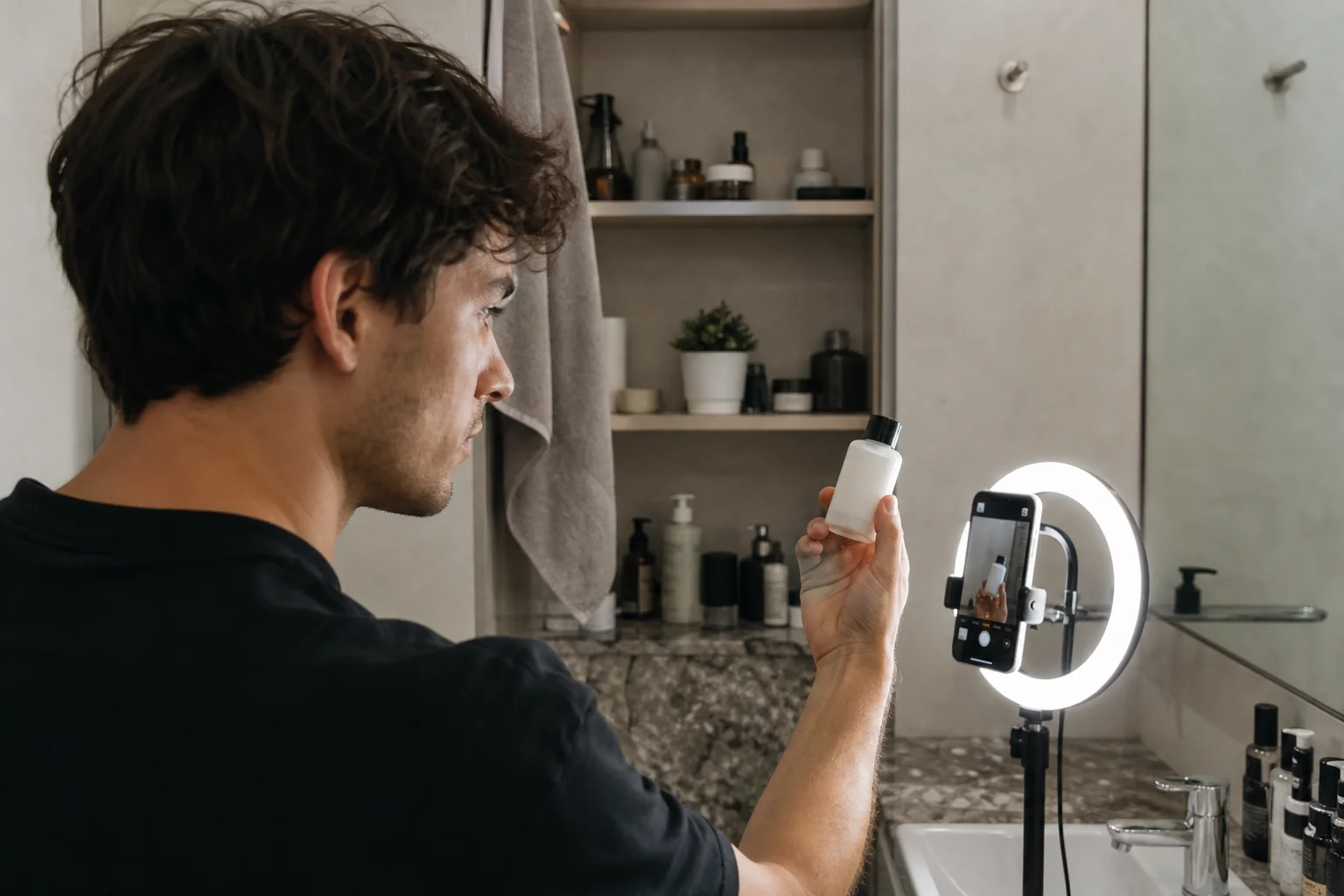
Here is a sequence that works for most small businesses:
- Find the moment. Trigger the ask off a 5-star review, a second purchase, a resolved support ticket, or right after delivery while the excitement is fresh.
- Ask where they already are. A line in the order confirmation email, a reply to their Instagram tag, a small card inside the package, or a short text message after delivery. Don't make them go find a form.
- Be specific about the ask. "Could you film a 15-second video of you opening it and tag us?" gets you far more usable content than "Let us know what you think!"
- Offer something real but modest. A discount code on their next order, early access to a new item, or a shoutout on your page. Keep it proportionate, this is a thank-you, not a commission.
- Get permission before you repost. A simple reply like "Love this, mind if we share it on our page and in a future ad?" and a yes in writing is enough (more on this below).
- Say thanks publicly. Reposting with credit is itself an incentive for the next customer to send something in.
A script you can copy for a DM reply: "This made our day! Would you be okay with us sharing this on our Instagram and maybe in an ad down the line? We'll always credit you."
A line you can drop into a post-purchase email: "Got a quick photo or video of [product] in action? Reply to this email or tag us, we love featuring real customers."
When Should I Pay a Creator Instead of Waiting on Customers?
Pay a creator when you need content on a schedule, for a specific message, or before you have enough customers posting on their own. Waiting on organic customer UGC works well for social proof, but it is slow and you can't control what you get.
Reach for a paid creator when:
- You're newer and don't have enough customers posting yet
- You need content for paid ads, where the hook, pacing and message matter
- You need a steady, predictable supply rather than whatever trickles in
- You need usage rights locked in from the start, not negotiated after the fact
If chasing down individual creators and negotiating flat fees sounds like more work than it's worth, this is the part of UGC that small businesses most often outsource. Repfie's Angelretailer and Campaign Builder let you set up a campaign where verified creators promote your product or service and you pay a commission only on confirmed sales, with the option to target creators by influence level, sales record and city, so you're not paying upfront for content that never converts.
What Usage Rights Do I Need Before I Repost UGC?
Before reusing anyone's photo or video, whether it came from a customer or a paid creator, get their explicit written permission stating where you can use it, for how long, and whether it's paid or a thank-you only. A thumbs-up emoji to a DM is enough for most small businesses; a verbal "sure, go ahead" is not, because you want a record if a question ever comes up later.
At minimum, nail down:
- Where: organic social only, or also paid ads, your website, email, and packaging
- How long: a one-time share, or ongoing use for a set period
- Paid or unpaid: whether the content was compensated, which changes what you owe them
- Credit: whether you'll tag or name them every time it's used
- Edits: whether you can crop, caption or trim the clip
- Takedown: what happens if they later ask you to stop using it
Keep the permission somewhere you can find it again, a saved DM, a checkbox on an upload form, or a line in a creator contract. This isn't about becoming a lawyer, it's about not having to guess six months from now whether you were allowed to put that video in an ad.
Where Should I Post UGC for the Best Return?
Post UGC closest to the moment a shopper is deciding whether to buy: product pages, checkout flows and paid ad creative tend to outperform a general social feed because the content answers the exact doubt a shopper has right then.
A few channels worth prioritizing:
- Product pages: a real customer photo or clip next to the buy button shows the item in an actual setting, not a studio
- Paid ad creative: UGC-style video often blends into a feed better than a polished studio shot, which is why it's become a default creative format for small-business ad accounts
- Post-purchase emails: featuring a past customer's content in a follow-up email reassures a buyer who is still deciding
- Your own social feed: reposting with credit keeps a visible, growing wall of real customers, which is itself an incentive for the next person to send something in
You don't need every channel on day one. Start with product pages and your own feed, since those cost nothing beyond the ask, then add paid creative once you have a few pieces worth testing.
Build a UGC Pipeline That Doesn't Depend on Luck
Asking customers one at a time works, but it's slow, and chasing individual creators for flat-fee deals takes real hours you probably don't have. The fastest way to keep a steady flow of content without either of those headaches is to let creators come to you with their own incentive to perform.
Repfie's Angelretailer and Campaign Builder put your product or service in front of verified creators who promote you and earn a commission only when a sale is confirmed, so your spend tracks directly to results instead of impressions. You can also target who sees your campaign by influence level, sales record and city, which matters if your product is local or niche.
Because every creator on Repfie goes through likeness verification, the person promoting your business is a checked, real human rather than a bot account padding out a follower count, which gives you a clearer read on who you're actually working with. It won't catch every bad actor, but it's a meaningfully better starting point than an open DM to a stranger with no verification at all.
FAQ
What does "UGC content" mean? UGC content stands for user-generated content: any photo, video, review or post about a business made by a real customer or an independent creator instead of the brand's own marketing team.
What does "UGCs" mean? "UGCs" is informal shorthand people use for multiple pieces of user-generated content, or sometimes for the group of UGC creators who make that type of content for brands.
How do I ask a customer for UGC content? Ask right after a good experience, such as a strong review, a reorder, or a solved support ticket, in a channel they already use, with a specific, modest ask like a 15-second video of the product in use, and a small thank-you such as a discount code.
Should I pay for UGC or just ask happy customers? Ask customers first since it's low-cost and reads as genuine proof. Pay a creator when you need content on a schedule, for a specific ad message, or before you have enough customers posting about you on their own.
What usage rights do I need before reposting a customer's photo or video? Get written permission stating where you can use it (social, ads, website, email), for how long, whether it was paid or a thank-you only, whether you'll credit them, and whether you can edit or crop it.
Where should a small business post UGC for the best return? Product pages, paid ad creative, post-purchase email flows and your own social feed tend to perform best, since the content shows up right where a shopper is already deciding whether to buy.
Show up as the real you
Repfie is the social platform where every profile is a verified, real person. Share your best shots, grow a following that trusts you, and earn from real recommendations.
Join Repfie free →